Black Friday is coming up soon. For retailers, this is a make or break time. For the rest of us consumers, it’s a question: “Are we buying the product we need/want or just being triggered with the discount?
A 40% discount can make something you never wanted feel impossible to resist. But does that actually explain why people buy – or not buy?
You’re scrolling through Instagram. An ad catches your eye.
40% OFF. TODAY ONLY.
There’s a countdown timer. Stock is running low. The offer ends at midnight.
Suddenly, you’re seriously considering buying something you hadn’t thought about five minutes ago. Sound familiar? It’s probably annoying as hell, but there’s a better than even chance that you go ahead an buy the thing anyway…
That’s the fascinating thing about Black Friday. A discount can flip a product from irrelevant to urgent in seconds. A question that doesn’t get asked enough is whether businesses are actually understanding what makes customers buy, or are they just hoping a bigger number does the job?
The psychology isn’t uniform
Fear of missing out is real. Messages like “Last chance to save” or “Only a few left” do influence behaviour. But not for everyone, and not in the same way.
Someone who’s been researching a product for three months sees a 40% discount and thinks: now’s the time.
Someone discovering a brand for the first time sees the same discount and thinks: but can I trust this?
Same offer. Two completely different purchasing decisions.
That gap is where most Black Friday campaigns fail.
The obvious fix usually isn’t the right one
Imagine your campaign is generating clicks. Customers are browsing, adding things to their cart, engaging with your ads.
But they’re not buying.
The reflex response is to increase the discount. Push it to 50%. Maybe 60%. See if that shifts things.
But what if price isn’t the actual problem?
Research from the Baymard Institute shows shoppers abandon purchases for all kinds of reasons: unexpected shipping costs, delivery uncertainty, not quite feeling ready. A bigger discount doesn’t solve any of those. And for businesses already spending heavily on Black Friday advertising, cutting margin further without understanding why customers are hesitating is a costly guess.
Before going deeper on the discount, ask: what’s actually missing?
Three campaigns, three very different bets
We built Dilog to help businesses explore exactly this kind of question before they commit budget to it. Even to get feedback and iterate before you spend the teams time on the full production.
Take three Black Friday campaigns:
Campaign A – The discount: “40% OFF SITEWIDE. OUR BIGGEST SALE OF THE YEAR.”
Campaign B – The urgency: “YOUR FAVOURITES WON’T WAIT. SALE ENDS MIDNIGHT.”
Campaign C – The value: “QUALITY YOU’LL LOVE LONG AFTER BLACK FRIDAY.”
Which one lands? And more importantly, why?
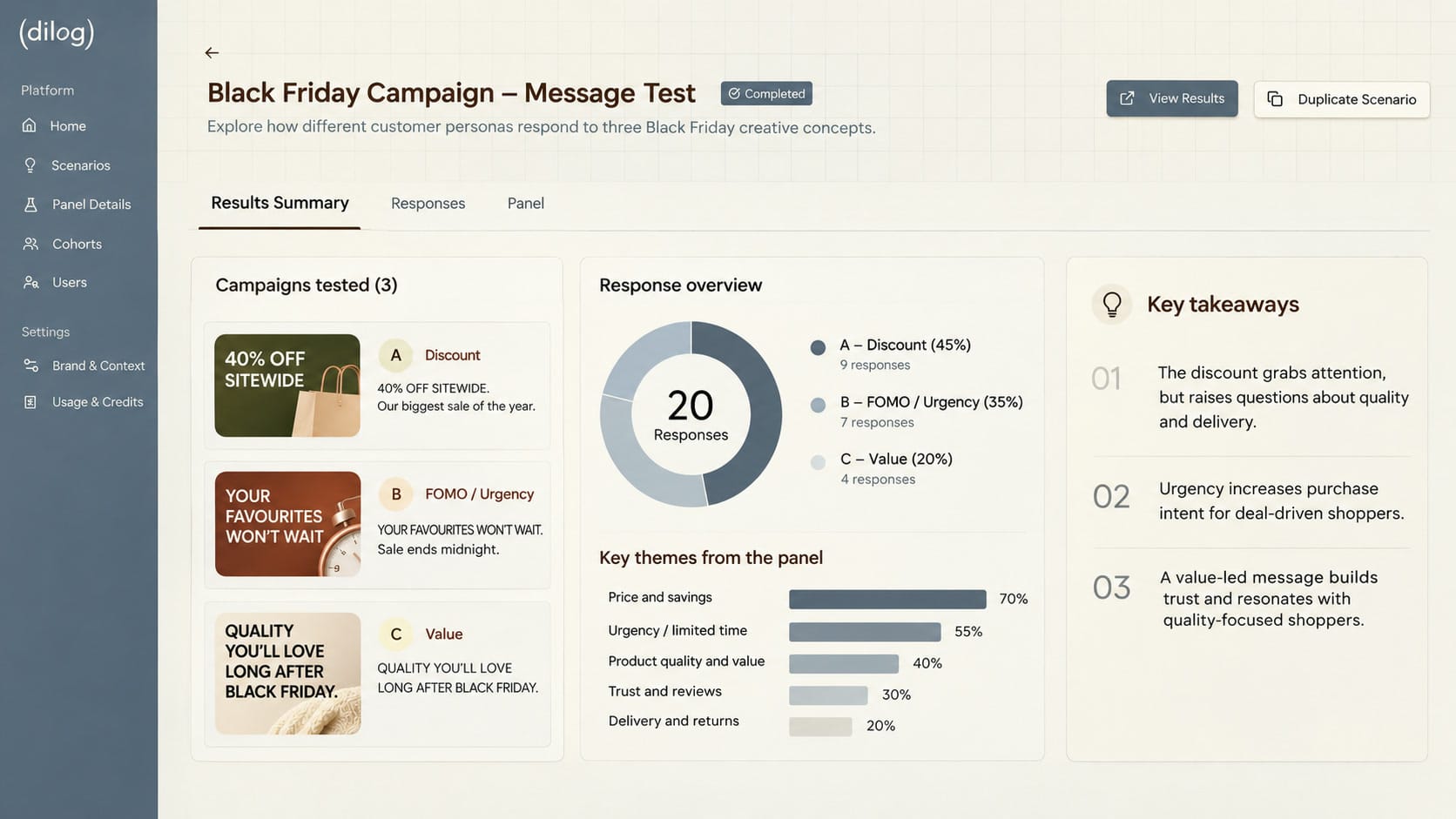
Using Dilog’s simulated research panels, built from real people’s personas rather than synthetic profiles, businesses can explore a variety of customer drivers for this instance. What captures attention, whether urgency creates interest or hesitation, and what information customers actually need before they’re ready to buy.
The panel’s responses are simulations, not direct customer feedback and not predictions of sales. But they give you a sharper starting point: they help you challenge assumptions and work out what’s actually worth testing before you go live.
For startups and smaller businesses without years of campaign data to lean on, that’s often the most useful thing you can get.
The most valuable insight isn’t which ad people prefer
It’s what might be stopping them from buying in the first place.
Black Friday isn’t just about who offers the biggest discount. It’s about understanding what makes different customers feel confident enough to actually follow through.
For some, that’s a great price. For others, it’s trust, product quality, or just finding the right information at the right moment.
We’re building Dilog to help businesses explore those differences before they commit time and money to a campaign. It’s a panel of agentic twins, built on real customers. Using it teams can ask unlimited questions, test unlimited ideas. Sometimes the answer to better conversions isn’t a bigger discount.
It’s a better understanding of who you’re selling to.
Curious what your customers might actually be thinking before they buy? We’ve written more on this at dilog.ai, including how persona-based research can help you test Black Friday messaging and investigate where hesitation really comes from.
Try it with your own question
Start your free trial and put your first question to a real customer panel in minutes.
Start your free trial